
 Water damage drying
 Fire & smoke cleanup
 Mold remediation
 Storm response
 Sewage cleanup
 Reconstruction
Free visual inspection and a written scope of work before any mitigation begins - photos, moisture readings, and drying logs go in your claim file
The scope we write is the scope we bill. Anything new gets shown to you, in writing, before we touch it.
Get your free estimateRestoration work we handle
See the difference
 Before
 After
After Before
 After
After Before
 After
AfterHow Much Does Storm & Disaster Restoration Cost in Austin?
Storm and disaster restoration in Austin, TX typically costs between $3,200 and $18,500 for most residential jobs in 2026, with water extraction and drying alone running $1,800 to $4,600 and full rebuilds after major storm damage reaching $25,000 to $75,000+ depending on structural involvement. These ranges reflect what we see across Travis County, Williamson County, and Hays County after the severe weather Austin gets each spring and fall. Every job we quote gets a written price before work starts, so you’ll know your exact number before a single piece of equipment comes off the truck.
Key Takeaways:
- Water extraction and drying: $1,800 – $4,600 (most common Austin scenario)
- Roof tarping and emergency board-up after storm damage: $450 – $1,800
- Full storm restoration with structural repair: $15,000 – $75,000, driven by square footage and material costs
- Mold remediation following water intrusion: $1,500 – $6,500 depending on containment needs
- Most Austin insurance policies cover storm and water damage, but deductibles (commonly 1% – 2% of dwelling coverage) determine your out-of-pocket portion
- Free estimates: call (361) 315-6142 and a live person answers, 24/7
Storm & Disaster Restoration Cost Breakdown (2026)
Here’s what we’re seeing on actual Austin jobs in 2026. These numbers come from our own completed work orders across neighborhoods like Allandale, Mueller, Circle C, and Wells Branch, not national averages that don’t reflect Central Texas labor rates, humidity, or the age of Austin’s housing stock.
| Service | Typical Austin Range (2026) | What It Includes |
|---|---|---|
| Emergency water extraction (single room) | $900 – $1,800 | Standing water removal, initial moisture mapping, baseboard assessment |
| Full structural drying (multiple rooms) | $1,800 – $4,600 | Commercial air movers, dehumidifiers, psychrometric readings (measuring moisture in the air and materials to confirm real dryness), daily monitoring |
| Roof tarping / emergency board-up | $450 – $1,800 | Temporary weatherproofing after wind or hail damage, plywood for broken windows, tarp secured to code |
| Sewage backup cleanup (Category 3 water) | $2,800 – $7,500 | Full containment, antimicrobial treatment, removal of contaminated materials, disposal per Austin/Travis County requirements |
| Mold remediation (after water intrusion) | $1,500 – $6,500 | Containment barriers, HEPA air scrubbers, removal of affected drywall/insulation, clearance testing |
| Storm debris removal (exterior) | $600 – $2,400 | Tree limbs, fencing material, damaged siding; haul-away included |
| Full storm restoration (structural) | $15,000 – $75,000+ | Framing repair, drywall replacement, flooring, painting, electrical/plumbing if storm damage requires it |
What moves you toward the top or bottom of these ranges comes down to a few things we assess on the first visit. Water that sat for more than 48 hours usually means drywall and insulation are coming out, not just getting dried. Homes in East Austin neighborhoods built before 1980 often have plaster walls instead of drywall, which can mean either easier drying (plaster resists water better) or more expensive repair if it has to come out. And the Texas heat plays a real role: in July and August, drying equipment works faster, but dehumidifiers run harder, so the electricity usage and equipment strain balance out.
What Affects Storm & Disaster Restoration Pricing in Austin
- Water category matters more than water volume. Clean water from a burst supply line is the least expensive to handle. Category 2 water (washing machine overflow, some roof leaks that picked up attic dust and insulation) costs more. Category 3 water, which includes sewage, flood water from storm surges, or anything that sat long enough to grow bacteria, requires full containment, disposal protocols, and antimicrobial treatment. The price difference between Category 1 and Category 3 on the same square footage can be $4,000 or more.
- How long the water sat before we arrive. Austin’s humidity means mold growth starts within 24 – 48 hours. If you caught the leak the same day, we’re mostly drying. If you found it after a weekend away, or after a storm knocked out power in Lakeway or Steiner Ranch and the leak went unnoticed, the scope expands. More tear-out, more equipment days, more disposal.
- Construction year and materials. Homes built in the last 15 years in areas like Leander, Pflugerville, and Round Rock tend to have modern materials that dry faster. Older homes (Hyde Park, Travis Heights, Bouldin Creek) often have layers of flooring, older electrical, or materials that absorb water differently. Plaster, as mentioned, actually holds up well but costs more to repair if it fails.
- Storm type and access. Hail damage that needs roof tarping is straightforward if the roof pitch is walkable. Steep roofs, multi-story homes in the Hill Country, or properties with Spanish tile (common west of MoPac) take longer and cost more for temporary protection. Wind-thrown debris against a single-story slab home is simpler than tree impact on a pier-and-beam structure in central Austin, which often means checking for foundation movement too.
- Insurance scope and adjuster timeline. Austin homeowners with named-storm coverage and a responsive adjuster can sometimes move faster. But after a city-wide hail event, adjusters get backed up for weeks. If you wait on the insurance company to approve, damage worsens and the final price goes up. That’s why we do the emergency work first (water extraction, tarping, board-up), document everything with photos, and coordinate with your adjuster. You’re not paying for scope creep because of billing delays; you’re paying for what the storm actually did.
- Contents and personal property. We don’t just dry the building. Furniture, rugs, electronics, family photos. Packing out contents costs money, but doing it fast saves more. A $600 pack-out and storage bill can prevent $8,000 in ruined belongings. In homes with lots of wood furniture (common in older Austin homes), the contents side of the estimate can be significant.
How to Save on Storm & Disaster Restoration
You can lower your final cost without cutting corners. Here’s what actually works in Austin:
- Shut off the water source immediately. If a pipe bursts, know where your main shutoff valve is before it ever happens. The 15 minutes it takes to find the valve is the difference between a $2,000 drying job and a $12,000 rebuild. This is the single biggest money-saver that never shows up in a cost guide.
- Call within the first two hours. The faster extraction starts, the less drying equipment you need and the fewer days the equipment runs. In Austin’s climate, every hour counts more than it does in drier cities like Phoenix or Denver. Mold starts working here quickly.
- Take photos and document everything before moving anything. Insurance claims go smoother when you have a clear record of what the storm did. Your adjuster will move faster, which means your restoration moves faster, which means less equipment time and lower bills. If you’re unsure what to photograph, call us and we’ll walk you through it while we’re on the way.
- Don’t wait on the insurance company to call back. Emergency mitigation is covered under virtually every Austin homeowners policy, and delaying makes the claim larger, not smaller. Your insurer would rather pay for extraction and drying now than a full gut-and-rebuild later. Get the emergency work started; the paperwork catches up.
- Get a written price before work starts. This is our standard practice on every job, and it protects you from estimates that balloon after demolition begins. The price we put in writing is the price you pay. If hidden damage is discovered after walls come open, we stop, show you what we found, and get your sign-off on the change before proceeding. No surprises.
- Ask about drying-only options when applicable. Not every wet wall needs to be opened. With the right psychrometric readings (measuring moisture content in building materials, not just the air), we can sometimes save drywall and insulation with targeted injection drying. That’s where equipment from Injectidry and Dri-Eaz, operated by technicians who actually know how to read the moisture maps, saves Austin homeowners thousands versus a less experienced crew that defaults to tear-out because it’s easier.
Marsh Water Damage Austin offers free estimates on storm and disaster restoration. Call (361) 315-6142 and we’ll give you a straight answer on price before you commit to anything.
Storm & Disaster Restoration in Austin: How We Work
Here’s what happens when you call us after a storm or water event in Austin. This process applies whether you’re in Tarrytown, Anderson Mill, Georgetown, or anywhere else in the metro area we serve.
- You call (361) 315-6142 and a live person answers. Not a voicemail, not a callback queue, not an answering service that promises someone will reach out tomorrow. A real person at our Austin office picks up, 24 hours a day, 7 days a week, including holidays. Water doesn’t wait for business hours, and neither do we.
- We tell you exactly who is coming. Before the technician leaves for your home, you receive their name and a photo. This is the Threshold Verified standard, and it’s non-negotiable on every visit. The person who shows up at your door is the person you were told to expect, and they’ll show you a photo ID badge before they step inside. If you’re home alone, or it’s late at night, or you’re a parent with young kids asleep in the back room, you should never have to wonder who’s at the door. You’ll already know.
- We assess the damage and write the scope. The technician walks the property with you, checks moisture levels in walls, floors, and ceilings, identifies the water category, and maps out exactly what needs to happen: extraction, drying, tear-out, rebuild, or all of the above. You get a written price before any work begins. Not an estimate with an asterisk. A written price.
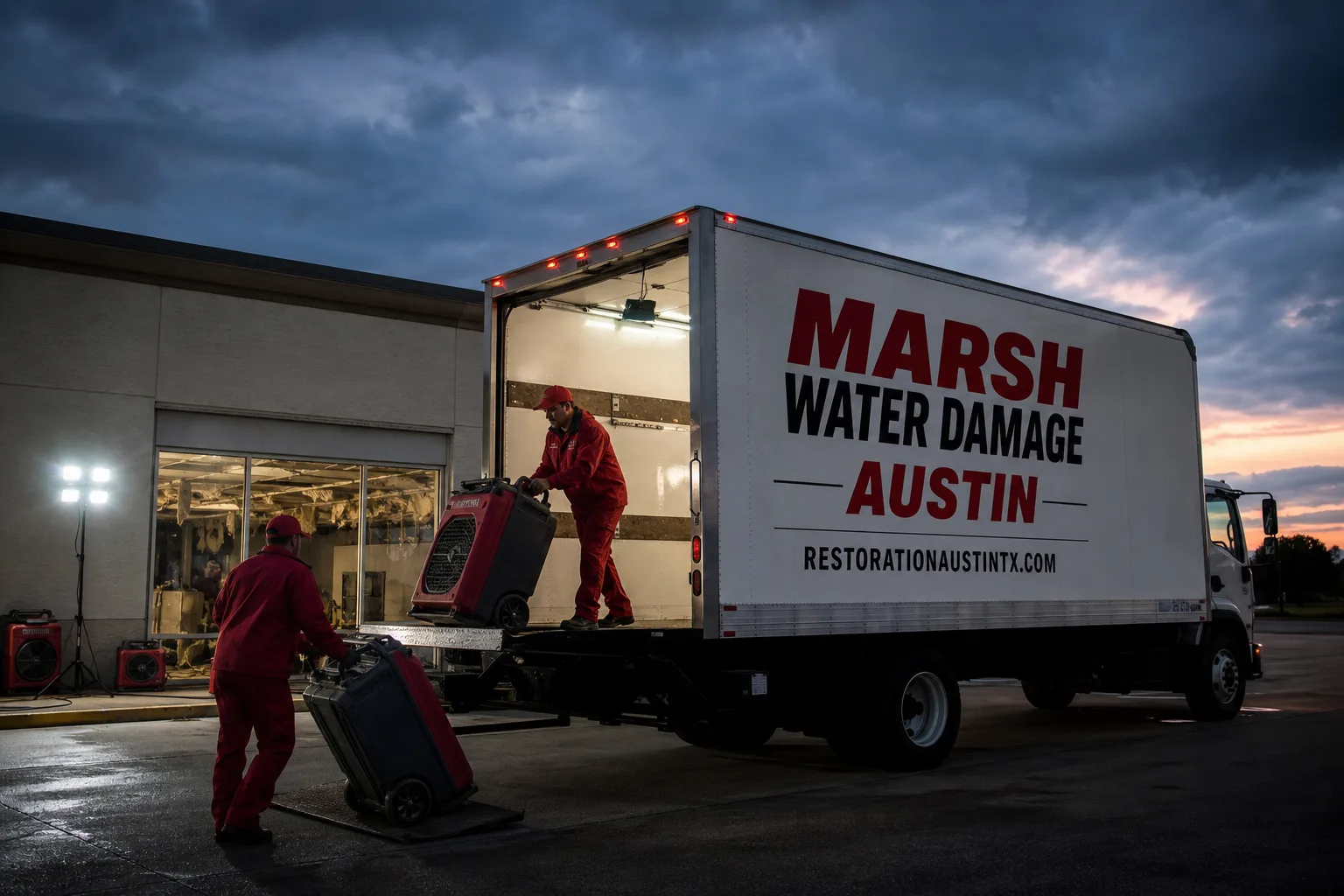
- We bring in the right equipment for your job. Depending on the scope, that might mean Dri-Eaz dehumidifiers, Phoenix air movers, XPOWER extraction units, B-Air dryers, or an Injectidry system for saving walls that would otherwise be torn open. Our technicians hold IICRC, RIA, and IFA credentials, which means they know how to use this equipment properly, not just plug it in and hope.
- We monitor until the structure is actually dry. This is where the psychrometric readings come in. Moisture meters in the wall cavities and humidity sensors in the air tell us when the job is done. Not when the surface feels dry to the touch, but when the building materials reach the moisture content they had before the storm. Surface-dry walls that are wet behind the paint will grow mold six weeks later. We don’t leave until the numbers say it’s right.
- You get a written guarantee, stamped on the work order. The 365-Day Done Right Promise is simple: if our repair is not right within a full year, we make it right. No fine print about “normal wear and tear,” no arguing about whether it was caused by something else. If our work fails, we come back and fix it, and the second visit is free. This isn’t a promotional offer. It’s printed on every work order we write, and it has been since 2005.
Learn more about how we handle storm and disaster work on our Storm & Disaster Restoration in Austin page, or head back to our home page to see everything we do.
What Does Storm Damage Restoration Actually Cover in Austin?
Storm damage in Austin means a few specific things in 2026, and they determine what you’ll pay. The most common calls we get fall into these categories:
Water Intrusion from Wind-Driven Rain
Austin gets intense spring thunderstorms with wind gusts strong enough to push rain sideways into window frames, under flashing, and through brick weep holes. This is water where it shouldn’t be, and the cost depends on how far it traveled. If it pooled on the floor, that’s an extraction and drying job ($1,800 – $4,600). If it ran down inside the wall cavity, you’re opening walls ($4,000 – $9,000). In neighborhoods like Crestview and Rosedale, where many homes still have original window flashing from the 1950s and 60s, wind-driven rain intrusion is a recurring spring storm issue.
Hail Damage to Roofs and Siding
Hail storms hit different parts of Austin differently. The April and May hail season tends to move through the western suburbs (Lakeway, Bee Cave, Dripping Springs) with more force, while the I-35 corridor gets frequent but smaller hail. Restoration after hail usually starts with tarping and temporary protection ($450 – $1,200 for most single-family homes), then moves into surface repair or roof replacement once the adjuster documents damage. Hail restoration then flows into interior water damage if the hail broke through roofing material.
Fallen Trees and Debris Impact
Live oaks, cedar elms, and pecan trees are beautiful until a microburst puts one through your roof. Austin’s older neighborhoods, especially Tarrytown, Old Enfield, and Pemberton Heights, have mature trees that predate the houses. When one comes down, you’re looking at structural damage: roof trusses, ceiling framing, insulation, drywall, electrical if the branch caught a wire on the way down. These are the $15,000 – $75,000 jobs, and they’re the ones where proper documentation and a fast response matter most for insurance.
Flash Flooding and Drainage Failure
Despite the name “Flash Flood Alley” applying to the whole Hill Country corridor, Austin proper sees localized flooding in specific low-lying areas and near creeks. Homes in the Barton Hills area, along Shoal Creek, and parts of the Onion Creek watershed are more vulnerable. Flood water is always Category 3, which means contaminated, and the restoration protocol is different: full removal of affected materials, antimicrobial treatment, and often electrical inspection before power is restored. Flash flood restoration is almost always an insurance claim, and the deductibles for flood coverage (separate from standard homeowner’s insurance) typically run higher than storm deductibles.
Does Homeowners Insurance Cover Storm Restoration in Austin?
Most standard homeowners policies in Texas cover wind, hail, and water damage from storms, but the details determine what you actually pay out of pocket. Here’s how it works in practice:
- Named storm deductibles are common in Texas. Many Austin policies carry a 1% or 2% deductible specifically for wind and hail claims, calculated on your dwelling coverage amount, not your total loss. On a $400,000 dwelling coverage limit, a 2% deductible means you pay the first $8,000. That doesn’t mean the claim isn’t worth filing; it means you should know your deductible before you decide.
- Flood damage requires separate flood insurance. Standard homeowners policies do not cover flooding from rising water, whether from Shoal Creek overflowing or a flash flood on your street. Flood insurance through FEMA’s NFIP or a private carrier is a separate policy. If your home flooded without flood insurance, the full restoration cost is out of pocket, which is why the price range is so broad on the top end.
- Emergency mitigation is typically covered. Insurance companies expect you to prevent further damage. Tarping a roof, extracting water, and setting up drying equipment are considered reasonable emergency measures. If you wait for the adjuster before doing anything, and the damage worsens, the insurer can argue you failed to mitigate. Don’t wait.
- We work with your adjuster directly. We document everything, provide the moisture readings and photos the adjuster needs, and invoice in the format insurance companies expect. This speeds up your claim and reduces back-and-forth. Since 2005, we’ve worked with every major insurer operating in Texas.
How Long Does Storm Restoration Take in Austin?
Timeline matters for two reasons: you want your life back, and the longer a structure stays wet, the more it costs. Here’s what to expect:
- Emergency response: same day, usually within 2 – 4 hours. When you call (361) 315-6142, our goal is to have a technician at your home the same day, and usually within a few hours. In a city-wide storm event, response times stretch. After the 2023 ice storm and the major hail events of recent years, every restoration company in Austin was overwhelmed. But our dispatch is local, not routed through a national call center, so we know Austin geography and can sequence calls intelligently.
- Water extraction and drying: 3 – 7 days. A typical Austin water intrusion with no major structural damage dries in three to five days. Larger jobs with multiple rooms and saturated insulation can run seven to ten days. The equipment runs continuously; our technicians check progress daily.
- Mold remediation: 1 – 3 days of active work. Containment goes up, affected materials come out, antimicrobial treatment goes on, and clearance testing confirms the air is clean. The physical work typically takes one to three days for a standard residential job.
- Structural rebuild: 2 – 8 weeks. This is the long pole. Once we’re past mitigation and into reconstruction, the timeline follows standard remodeling logic: framing repair, drywall, paint, flooring, finish work. A moderate rebuild on a 2,000 square foot home in Austin runs four to six weeks if materials are available. Supply chain issues have mostly normalized since 2022, but custom materials (certain tile, specific flooring) can still add weeks.
FAQs – Storm & Disaster Restoration Cost
How much does water damage restoration cost in Austin?
Water damage restoration in Austin typically costs between $1,800 and $4,600 for extraction and full structural drying, which is the bulk of most water intrusion jobs. Small, single-room incidents can come in around $900 to $1,800 if the water was clean and caught quickly. Jobs involving sewage or long-standing water run $2,800 to $7,500 because of containment and disposal requirements. Call (361) 315-6142 for an exact quote; the estimate is free and a live person answers.
Is it cheaper to repair or replace storm-damaged drywall?
In Austin’s market, repairing storm-damaged drywall typically costs $500 to $1,800 per room when the damage is localized, while full replacement of drywall, insulation, and trim runs $2,500 to $6,500 per room depending on ceiling height and finish level. The decision isn’t price alone: drywall that was saturated with contaminated water should always be replaced, not repaired, because the paper backing and gypsum core hold bacteria and mold. We’ll show you the moisture readings and make a recommendation based on the actual numbers, not a guess.
How much does emergency roof tarping cost in Austin?
Emergency roof tarping in Austin typically runs $450 to $1,200 for a standard single-story home, and up to $1,800 for steep pitches, multi-story homes, or complex roof geometries common in newer Hill Country construction. The price includes securing the tarp to code so it holds through a Texas thunderstorm, which matters more than the tarp itself. We recommend calling immediately after hail or wind damage; the longer water gets in, the more the total restoration costs.
Can you come today for storm damage?
Yes. Marsh Water Damage Austin has a live person answering phones 24/7, and our goal is same-day emergency response, typically within 2 to 4 hours for storm damage in the Austin metro area. During city-wide events, response times stretch, but we sequence calls by severity and geography, not by who called first. If you’ve got water actively entering the home or sewage backing up, tell the person on the phone and we’ll prioritize your call.
How much does mold remediation cost after a storm in Austin?
Mold remediation after storm or water damage in Austin typically costs $1,500 to $6,500 for a standard residential project, which includes containment barriers, HEPA air scrubbing, removal of affected materials, antimicrobial treatment, and clearance testing. Larger jobs, or mold that has spread into HVAC systems, can exceed $8,000. The cost is driven by square footage, accessibility, and how far the mold penetrated. Call (361) 315-6142 for a free assessment and written price.
Why Austin Homeowners Choose Marsh Water Damage Restoration
Since 2005, we’ve been the restoration brand of the Threshold Group family, serving Austin and the surrounding communities with a standard that goes beyond what most restoration companies offer. The name says what we deal with: a marsh is low, wet ground, water where it shouldn’t be. That’s the problem we solve every day.
The difference is in how we show up. Every technician who comes to your home is background-checked, identity-verified, uniformed, and photo-badged under the Threshold Verified standard. Before they arrive, you’ll know their name and see their face. When they get to your door, they’ll show you a photo ID badge. Every time, not just on the first visit. For homeowners who are home alone, parents with young children, or older Austin residents, this matters as much as the quality of the drying equipment.
Our equipment is the same gear used in large commercial losses: Dri-Eaz dehumidifiers, Phoenix air movers, XPOWER extraction units, B-Air dryers, and Injectidry systems for saving walls that would otherwise be torn out. Our technicians hold credentials from IICRC, RIA, and IFA, the organizations that set the restoration industry’s training standards. The equipment is only as good as the person reading the moisture meter, and our people know what the numbers mean.
And every job, from a $900 extraction to a $75,000 rebuild, comes with the same three commitments: a written price before work begins, a written guarantee on every repair, and the 365-Day Done Right Promise. If the repair fails within a year, we make it right, and the second visit is free. Not because you argued for it. Because it’s printed on the work order before we ever start.
Led by Tobias Reyner, our Austin team has handled storm and water restoration across every corner of this city: the pier-and-beam homes of Hyde Park, the slab construction of the suburbs, the hillside properties west of MoPac, the flood-prone corridors along the creeks. We know Austin’s building stock, its storm patterns, and its insurance landscape.
Get Your Free Storm Restoration Estimate in Austin
If you’re dealing with storm damage, water intrusion, or the aftermath of a disaster, don’t wait. The longer water sits, the more it costs to fix. Call (361) 315-6142 now. A live person answers, 24 hours a day, 7 days a week. We’ll give you a straight answer on what you’re looking at, schedule a same-day visit when you need it, and tell you exactly who is coming before they arrive. The estimate is free, the price is written before work starts, and the guarantee is 365 days.
Pricing reflects the Austin market as of 2026. Marsh Water Damage Austin offers free estimates – call (361) 315-6142.
What Our Customers Say
"Daily moisture readings were shared on my phone, so I knew when the drying was done. No surprises."
- Fiona K."Knowing the techs were background checked was a big deal with them working in our home for days. Respectful and careful with our belongings."
- Priya S."Mold test came back clean after their drying. Peace of mind for us."
- Lydia F.