
 Water damage drying
 Fire & smoke cleanup
 Mold remediation
 Storm response
 Sewage cleanup
 Reconstruction
Free visual inspection and a written scope of work before any mitigation begins - photos, moisture readings, and drying logs go in your claim file
The scope we write is the scope we bill. Anything new gets shown to you, in writing, before we touch it.
Get your free estimateFast, Reliable Storm Damage Restoration Across Camp Swift
Storm damage in Camp Swift rarely shows up the way the forecast suggested it would. You check the roof, see a few lifted shingles, maybe a branch down in the yard. Then three weeks later the hallway floor feels spongy and there’s a musty smell coming from the crawlspace. That’s the Camp Swift signature: sandy soil drinks the surface water, holds it underneath your pier-and-beam floor, and the real damage starts after the puddles are gone. Our Storm Damage Restoration crews respond to Camp Swift homes within hours, not days. Call (361) 315-6142 any time, day or night, and a live person answers.
Why Marsh Water Damage Austin Is Camp Swift’s Preferred Storm Damage Restoration Company
We’ve worked enough storm losses in Camp Swift to know exactly what we’re walking into before the equipment comes off the truck. A 1980s pier-and-beam house on the east side behaves differently after a thunderstorm than a 1990s slab home with brick veneer near the western edge. That local knowledge isn’t something you get from a franchise dispatched out of a call center two hundred miles away. It’s the reason Camp Swift homeowners keep our number in their phones.
Every Marsh Water Damage Austin technician who shows up at your door is background-checked, identity-verified, uniformed, and photo-badged under the Threshold Verified standard. Before the visit, you get the technician’s name and photo sent to you. When they knock, they hold up a photo ID badge. You know exactly who is at your door before you open it. Tobias Reyner leads our restoration team, and the same standards apply to every job: a written price before any work starts, a written guarantee on every repair, and our 365-Day Done Right Promise printed on the work order. Not as a pitch. As a printed commitment.
Restoration work we handle
Flood Restoration in Camp Swift
Flood Restoration in Camp Swift typically runs between $3,200 and $8,500 for a standard single-story home when category 2 water (storm runoff, creek overflow) has entered living spaces and requires extraction, drying, and sanitizing. If the water came from flash flooding off nearby creeks, that’s category 2 or category 3 water depending on what it carried with it. We test, we don’t guess, and you get the written number before we open a wall.
Water Extraction and Structural Drying
Water extraction on a Camp Swift flood job starts with truck-mounted extraction pulling standing water out of carpet, pad, and hard surfaces. Then the drying plan begins. We take psychrometric readings (measuring the moisture in the air and materials) to know when your structure is genuinely dry, not just dry on the surface. For Camp Swift’s hot, humid summers, this step matters more than homeowners expect. Air that’s already heavy with humidity slows natural drying to a crawl, so we set commercial air movers and dehumidifiers to control the environment inside the home.
Flooring and Subfloor Restoration
In Camp Swift’s pier-and-beam homes, flood restoration almost always involves the crawlspace. Water moves through sand quickly but then sits underneath the floor joists, raising moisture readings for weeks. We check subfloor moisture with penetrating meters, not just surface readers. If readings are over 20%, we pull the wet insulation, treat the framing, and set up containment before laying anything back down. Skipping this step is how homeowners end up with floor warping they mistake for foundation problems months later.
Basement Flood Cleanup in Camp Swift
Basement Flood Cleanup in Camp Swift, where basements are less common but do appear in some of the older and custom-built homes, usually runs between $1,800 and $4,200 for a partial basement flood involving a few inches of water and affected drywall and flooring. Full basement floods with finished living space and category 3 water can push past $8,000. The number depends on how much water entered, how long it sat, and what finished materials it touched.
Category 2 and Category 3 Water Handling
Basement water from storm surge or sewage backup is never safe to handle as a DIY mop-up. Category 2 water carries contaminants, and category 3 water carries pathogens. We wear proper PPE, remove the affected materials, and apply antimicrobial treatment to the remaining structure. The goal is not just dry. The goal is safe to live in again.
Containment and Air Filtration
When we cut into wet drywall or pull wet carpet in a Camp Swift basement, we set up containment and run HEPA air scrubbers. Why does that matter to you? Because mold spores from damaged materials become airborne the second demolition starts. Without containment, you spread whatever was growing behind that drywall into every room of the house. On brick veneer homes especially, this is where hidden damage gets worse. We contain first, demo second.
Trusted Brands We Service in Camp Swift
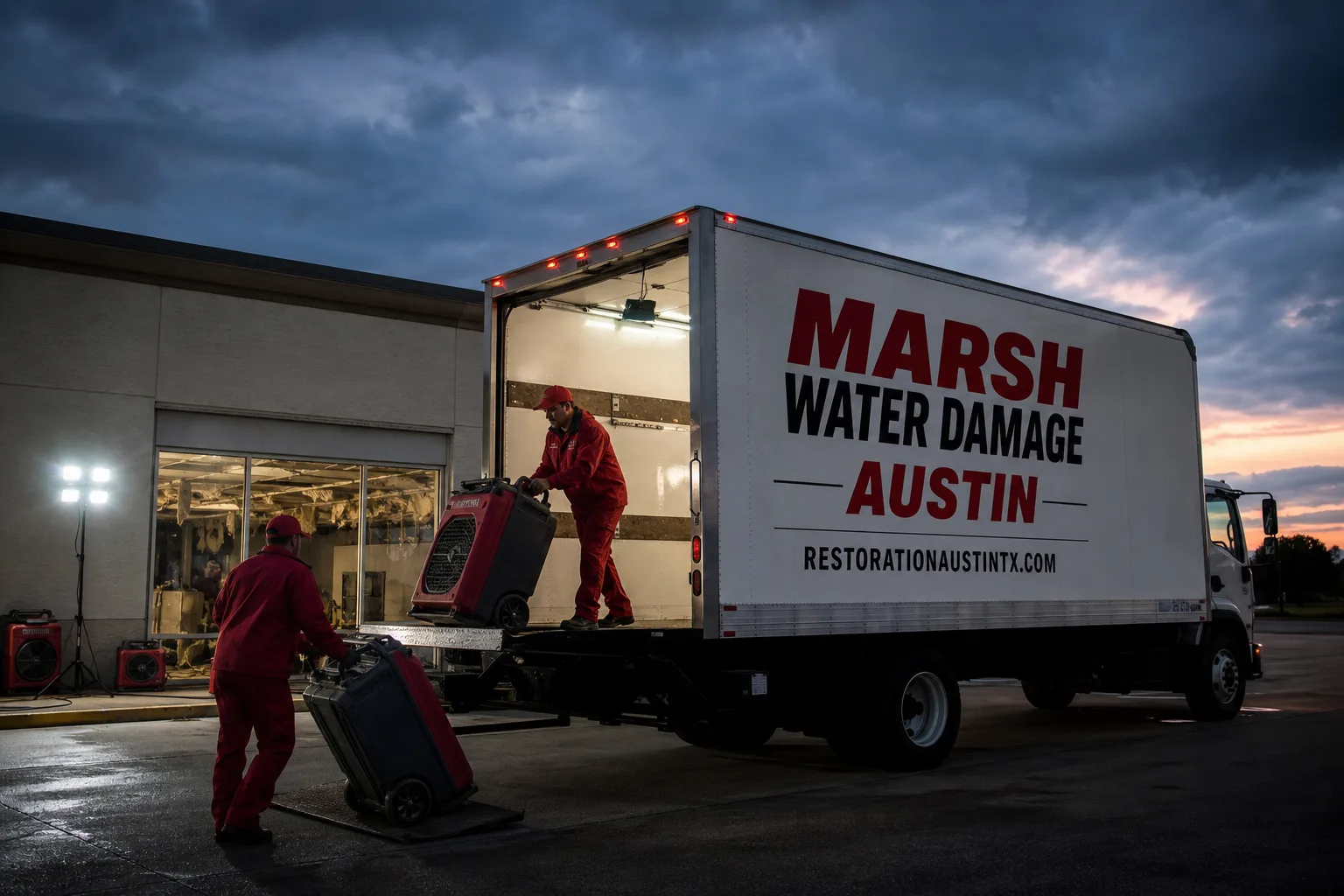
We run Phoenix and XPOWER extraction units on Camp Swift storm jobs, paired with Dri-Eaz dehumidifiers and air movers. These are the same commercial-grade units used on large industrial losses. For homeowners, that means faster drying times, fewer equipment failures mid-job, and a drying plan built around actual measured progress rather than a rental unit from a hardware store. We keep common replacement parts on our trucks so a Camp Swift job doesn’t stall waiting on a part shipped from out of state.
Common Storm Damage Restoration Problems We See in Camp Swift Homes
- Spongy floors weeks after the storm. Camp Swift’s sandy soil moves water away from the surface fast, so the ground looks dry. But water that pooled under a pier-and-beam home sits there, keeping subfloor moisture readings elevated. You feel the softness in the floor before you smell anything.
- Mold hidden behind brick veneer. Brick looks solid and waterproof, but storm water driven against the wall finds its way behind the veneer and into the wall cavity. Without containment and moisture mapping, that mold spreads into areas you can’t see until the smell gives it away.
- Cupping vinyl flooring on 1970s slab homes. Vinyl flooring traps moisture against the slab. If a storm pushed water under the flooring and nobody checked moisture mapping underneath, the slab stays wet for months. Cupping and curling show up long after the insurance claim closed.
- Warped framing from wet insulation. Wet insulation pressed against floor joists or wall studs holds moisture against the wood. In Camp Swift’s humid summers, that framing can start to warp and grow mold before the insulation even feels damp on the outside.
See the difference
 Before
 After
After Before
 After
After Before
 After
AfterPricing for Storm Damage Restoration in Camp Swift, TX
We Also Serve Cities Near Camp Swift
Our Storm Damage Restoration in Camp Swift crews also run jobs into Austin, Georgetown, Cedar Park, and Brushy Creek. If you’re in one of those areas and need storm damage help, the same written-price, photo-badge, and 365-Day Done Right Promise standards apply. Same live-person phone answer, same equipment, same technician verification.
Serving Camp Swift, TX - Our Local Coverage Area
We’re based in the Camp Swift area and know this community well. Use the map below to see our service coverage - if you’re nearby, we can almost certainly help.
FAQs About Storm Damage Restoration in Camp Swift
Why does my Camp Swift pier-and-beam floor feel spongy weeks after a storm, even though the ground looks dry?
Because water moves through Camp Swift’s sandy soil quickly, leaving the surface dry while moisture stays trapped underneath your floor joists. That elevated moisture causes wood to swell and soften, which you feel as a spongy floor. This requires moisture mapping under the house and structural drying, not just running a dehumidifier in the living room. Call (361) 315-6142 and we’ll check subfloor moisture readings before recommending any repair scope.
How fast can mold start growing on wet drywall after a Camp Swift thunderstorm?
Mold can begin growing on wet drywall within 24 to 48 hours in Camp Swift’s warm, humid conditions, which is a shorter window than drier climates. If the drywall has been wet for more than two days, it should likely be removed rather than dried in place. The fastest safe answer is extraction and air movement within the first day. Call (361) 315-6142 for an assessment.
Do I need a pack-out for storm damage in a Camp Swift brick veneer home?
Not always. Pack-out means we inventory, photograph, and move your belongings out of the affected area so we can work safely and your items don’t absorb more moisture. In brick veneer homes where moisture got behind the veneer and into wall cavities, pack-out is often needed for the rooms being opened. The written scope tells you upfront if pack-out applies, and your adjuster gets the photo documentation directly from us.
What’s the difference between flood restoration and basement flood cleanup for Camp Swift homes?
Flood restoration covers standing water that entered from storm runoff or creek overflow into main living areas. Basement flood cleanup is more contained, usually below grade, and often involves category 2 or 3 water that needs different handling. In Camp Swift, the distinction matters most for pier-and-beam homes where the “basement” is really the crawlspace, and the water there affects your subfloor rather than a finished basement room. Call (361) 315-6142 and we’ll tell you which scope applies to your home.
Why do local restoration crews check east-side homes first after a big storm in Camp Swift?
East-side Camp Swift has a higher concentration of older pier-and-beam homes, and the sandy soil there shifts after heavy rain, letting water pool underneath floors. That hidden water causes warping and mold long after surface water is gone, so crews prioritize those homes to stop damage before it spreads. Marsh Water Damage Austin includes this east-side check in our storm response for Camp Swift.
Call Marsh Water Damage Austin for Storm Damage Restoration in Camp Swift
When a thunderstorm passes through Camp Swift, the clock starts on water damage. Every hour that water sits in your crawlspace or behind your brick veneer increases the damage and the final bill. We answer the phone 24/7 with a live person at (361) 315-6142. We send a background-checked, photo-badged technician whose name and face you receive before the visit. You get a written price before work starts, a written guarantee, and a 365-Day Done Right Promise on every job. Call now for a free estimate, and we’ll tell you exactly what’s going on under those floors.
Written by Tobias Reyner, Owner at Marsh Water Damage Austin, serving Camp Swift and surrounding communities since 2005.