
 Water damage drying
 Fire & smoke cleanup
 Mold remediation
 Storm response
 Sewage cleanup
 Reconstruction
Free visual inspection and a written scope of work before any mitigation begins - photos, moisture readings, and drying logs go in your claim file
The scope we write is the scope we bill. Anything new gets shown to you, in writing, before we touch it.
Get your free estimateFast, Reliable Storm Damage Restoration Across Lost Creek
Storm damage in Lost Creek doesn’t wait for a convenient moment. When wind tears shingles off a roof on Winding Ridge Drive or a thunderstorm pushes water under a door on Tumbleweed Trail, the clock starts immediately. Marsh Water Damage Austin responds to Lost Creek homes around the clock. A live person answers at (361) 315-6142, day or night, and dispatches a crew that knows the tight streets, steep driveways, and mature oaks that make this neighborhood different from anywhere else in the Austin area. We don’t route calls through a call center. You tell us what happened, and we tell you exactly who is coming to your door, by name and photo, before they arrive.
Why Marsh Water Damage Austin Is Lost Creek’s Preferred Storm Damage Restoration Company
Lost Creek homeowners call us because we understand what a storm actually does to these particular houses. The streets wind, the lots slope, and the clay-heavy soil holds water against foundation walls in ways that flat neighborhoods never experience. Our technicians have worked storms across Lost Creek from the western ridges near Barton Creek to the lower streets that drain toward the greenbelt. We’ve seen the pattern after heavy rain: water doesn’t just sit on the surface here. It works its way down, following the slope, pressing against slab edges and seeping into lower-level rooms. That’s why our Storm Damage Restoration approach starts with moisture mapping, not just extraction.
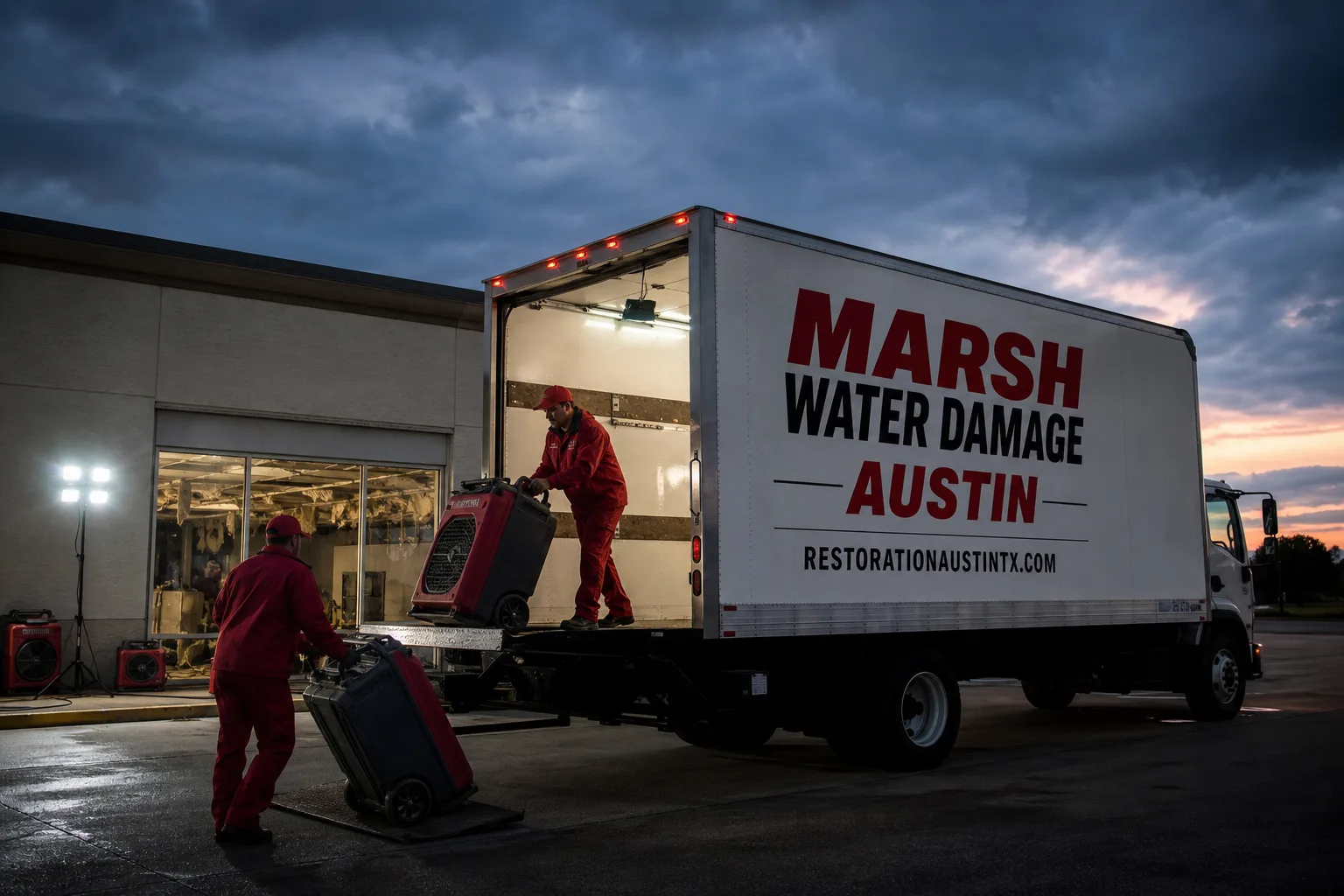
Tobias Reyner, who leads our restoration team, requires every technician to carry IICRC, RIA, and IFA credentials. These are the restoration industry’s recognized training bodies, and they matter when you’re dealing with a flooded finished basement in a custom 1970s home. The gear we bring matches what large commercial restoration firms use: Dri-Eaz dehumidifiers, Phoenix air movers, thermal imaging cameras that read moisture behind brick and stone veneers. Lost Creek homes were built to a high standard, and restoring them requires more than a shop vac and a fan.
Every technician who comes to your door has passed a background check, carries a photo ID badge, and arrives in uniform. Before dispatch, you receive their name and photo. This is the Threshold Verified standard, and it’s not optional on any Marsh job. We know many Lost Creek residents are home alone during the day, or have young children, or simply don’t want to open the door to an unvetted crew. Neither would we.
Restoration work we handle
Flood Cleanup in Lost Creek
Flood Cleanup in Lost Creek means dealing with water that has entered finished living spaces after a storm, a creek overflow, or a drainage failure on a sloped lot. This is the work we do most often in the neighborhood after heavy rain events. It involves extraction, removal of saturated materials, structural drying, and sanitizing. A typical flood cleanup in Lost Creek runs $2,800 to $6,500 depending on the square footage affected and how far water has traveled under flooring and into wall cavities. When water has sat for more than 24 hours, or when the source is a creek overflow carrying silt and organic matter, costs rise because removal and sanitizing requirements increase.
Slab-Level Drying on Sloped Lots
Lost Creek’s clay-heavy soil changes how we dry a flooded lower level. Water doesn’t just sit on top of the slab. It wicks into the concrete, and it can travel horizontally under LVP, tile, or hardwood without ever being visible on the surface. We use thermal imaging and penetrating moisture meters to map the full extent of the water before we set equipment. Skipping this step on a sloped lot means hidden water stays trapped under flooring, and mold grows where nobody can see it until the smell gives it away.
Containment During Multi-Day Storms
Central Texas storms rarely arrive as a single event. They come in bands, and Lost Creek’s tightly clustered homes create a specific problem: wind-driven rain can re-enter a home while it’s drying. We set secondary containment and monitor it through the entire drying cycle. If another cell moves through, the containment holds and the drying continues. Without it, a second wave of rain undoes everything the first crew accomplished.
Flooded House in Lost Creek
A Flooded House in Lost Creek is a different level of emergency. This typically means water has entered multiple rooms, often from a combination of roof damage and ground-level intrusion during a severe thunderstorm. We respond to these calls with a full crew and commercial-grade extraction equipment. A flooded house restoration in Lost Creek typically costs $6,500 to $18,000, depending on how many levels are affected, whether the attic and roof structure are involved, and how quickly we can begin extraction. Custom homes from the 1970s through the 1990s often have large attic spaces and original plumbing that complicate the job, but we know those construction patterns and plan for them.
Roof Damage and Attic Water
When storm damage opens the roof envelope, water travels fast through the attic and into wall cavities, often behind brick or stone exteriors where it’s invisible from inside the room. We inspect the attic space first, then trace water paths down through wall cavities using moisture mapping. This is the reason we don’t do one-size drying plans in Lost Creek. A standard drying plan on a 1980s custom home with a large attic will miss water trapped behind stone veneer, and the homeowner won’t know until mold appears months later.
Our Work on Winding Ridge Drive
Our crew responded to a flooded house on Winding Ridge Drive after a severe thunderstorm overwhelmed the steep driveway drainage. Water had entered the finished lower level and traveled under the hardwood. We set containments, mapped moisture with thermal imaging to find water that had wicked into the slab, and ran Dri-Eaz dehumidifiers and XPOWER air movers for five days until moisture readings matched the pre-loss condition. This is what a flooded house in Lost Creek actually requires. Not a quick extraction and a promise, but a documented drying process that verifies the structure is dry below the surface, not just on top of it.
Trusted Brands We Service in Lost Creek
Lost Creek homes are custom built, often with premium building materials and original fixtures that deserve careful handling. We service every major restoration and drying equipment brand, including Dri-Eaz and Phoenix systems, and our technicians are trained on the specific operational requirements of each. When equipment needs replacement parts or your system needs a specific drying configuration after a storm, we coordinate directly with suppliers to get what’s needed. For Lost Creek customers, that means we don’t show up with whatever is on the truck. We show up with the right equipment for your specific house and your specific damage. Fast turnaround on parts and equipment keeps your restoration on schedule.
See the difference
 Before
 After
After Before
 After
After Before
 After
AfterCommon Storm Damage Restoration Problems We See in Lost Creek Homes
- Hidden slab moisture on clay-heavy soil. Water seeps into lower levels and wicks into the concrete slab, where it stays invisible under flooring until we map it with thermal imaging. Mold under slab-level LVP or hardwood is the result when this step gets skipped.
- Re-contamination during multi-day storm events. Tightly clustered homes on steep lots allow wind-driven rain and overflow to re-enter a drying space if secondary containment isn’t set and monitored. A second storm cell can undo days of drying.
- Incomplete drying behind brick and stone exteriors. Original 1970s-1990s construction with brick or stone veneers traps water in wall cavities. Standard drying plans don’t reach these spaces, and homeowners discover the problem months later.
- Original plumbing failures during storm events. Many Lost Creek homes still have original plumbing systems now at the end of their service life. Heavy rain saturates the soil, the ground shifts slightly, and aging pipes fail. Storm restoration often reveals plumbing damage that needs immediate attention.
Pricing for Storm Damage Restoration in Lost Creek, TX
We Also Serve Cities Near Lost Creek
Our storm damage restoration crews serve Lost Creek and the surrounding communities including Austin, Georgetown, Cedar Park, and Brushy Creek. We know the soil conditions, building styles, and storm patterns across the region, and we apply the same Threshold Verified standard on every job. If you’re in Lost Creek or nearby, call (361) 315-6142.
Serving Lost Creek, TX - Our Local Coverage Area
We’re based in the Lost Creek area and know this community well. Use the map below to see our service coverage - if you’re nearby, we can almost certainly help.
FAQs About Storm Damage Restoration in Lost Creek
Why does my Lost Creek basement seep water after heavy rain when the house sits on a hill?
The hill is exactly the problem. Lost Creek sits on clay-heavy soil that expands when wet, and on sloped lots that water flows down and presses against foundation walls. The water doesn’t need to rise from below; it’s being pushed sideways into your lower level by the saturated clay against the slab edge. We map the moisture below the surface to find how far it has traveled.
How quickly can mold start growing on soaked drywall in Lost Creek’s humid summers?
In Lost Creek’s summer heat and humidity, mold can begin colonizing soaked drywall within 24 to 48 hours. That’s the window where drying matters most. If water has been present for more than a day, you’re not just drying; you’re removing and sanitizing. Call us at (361) 315-6142 and we’ll tell you honestly whether drying or removal is the right call.
Do I need to replace all drywall that got wet from a creek overflow?
Usually, yes. Creek overflow water carries silt, organic matter, and bacteria that regular drying can’t remove. Drywall is porous, and once contaminated water has soaked into it, the material can’t be sanitized effectively. We cut out the affected sections, dry the framing behind them, and document everything for your insurance claim.
Can your crew stabilize my home if the storm damaged the roof and rain is still coming into the attic?
Yes. We tarp the damaged roof area, set containment in the attic access, and begin extracting water from the attic and the rooms below. The goal is to stop the active water intrusion first, then map the full extent of what got wet. We don’t wait for the rain to stop, because in Lost Creek summer storm systems, waiting means more damage.
What does “pre-loss condition” mean for my custom 1970s home with original materials?
Pre-loss condition means restoring your home to the condition it was in before the storm, not rebuilding it to 2026 code or replacing original materials with modern equivalents unless they can’t be saved. For a custom 1970s Lost Creek home, that means matching the original finishes and construction methods wherever possible, and documenting what we couldn’t save for your insurance adjuster. We give you a written scope with that standard printed on it.
Storm damage in Lost Creek demands a specific kind of restoration: one that understands clay-heavy soil, sloped lots, custom construction, and the 24-to-48-hour Lost Creek Mold Remediation clock in a humid Texas summer. Marsh Water Damage Austin brings that understanding, along with a written price before work starts and a written guarantee on every repair. Call (361) 315-6142 and a live person will answer, any hour, any day.
Written by Tobias Reyner, Owner at Marsh Water Damage Austin, serving Lost Creek since 2005.