
 Water damage drying
 Fire & smoke cleanup
 Mold remediation
 Storm response
 Sewage cleanup
 Reconstruction
Free visual inspection and a written scope of work before any mitigation begins - photos, moisture readings, and drying logs go in your claim file
The scope we write is the scope we bill. Anything new gets shown to you, in writing, before we touch it.
Get your free estimateFast, Reliable Water Damage Restoration Across Camp Swift
Water damage in Camp Swift moves fast, and so do we. Most residential water extractions in Camp Swift run between $1,200 and $3,800 before drying equipment is set, and our crews typically arrive within 60 to 90 minutes of your call. Toby Reyner leads our Camp Swift response team, and he’s walked enough pier-and-beam crawlspaces on the east side to know exactly where water hides after a storm. Call (361) 315-6142 any hour, and a live person answers. Not a voicemail. Not a callback queue. Someone who can dispatch a crew to your street.
We’ve been doing Water Damage Restoration across this part of Bastrop County since 2005, and Camp Swift’s particular mix of sandy soil, aging foundations, and fast-growing vegetation shapes how we approach every job here.
Why Marsh Water Damage Austin Is Camp Swift’s Preferred Water Damage Restoration Company
Camp Swift homeowners don’t want a stranger walking through their front door at 2 a.m. neither do we. That’s why every technician we send operates under the Threshold Verified standard: background-checked, identity-verified, and sent to you by name and photo before the visit. When our tech knocks, they show a photo ID badge. Every time. No exceptions.
Our Camp Swift customers tend to hear about us from a neighbor, which fits. This is a tight-knit community between Bastrop and Elgin, and word travels when someone shows up on time and does the job right. We carry IICRC, RIA, and IFA credentials on our technical team, and we run Dri-Eaz and Phoenix equipment, the same gear used on large commercial losses. Applied to a single-family home on a quiet Camp Swift street.
Response time to Camp Swift runs 60 to 90 minutes for emergency water extraction. That matters here because the humidity doesn’t give you much of a window before mold starts. More on that below.
Restoration work we handle
Water Damage Repair in Camp Swift
Water damage repair in Camp Swift means restoring your home to its pre-loss condition after water has done its damage, whether that’s replacing warped flooring, repairing drywall, or treating framing that’s been sitting wet too long. Most repair work in Camp Swift runs $2,500 to $7,000 depending on how far the water traveled and what got saturated. We write the price down before any work starts, so you’re not staring at a surprise invoice after demo begins.
Pier-and-Beam Floor Repair
The east side of Camp Swift sits on sandy soil that shifts. When water pools under a pier-and-beam home, the subfloor absorbs it and the oak or pine flooring above starts to cup and warp. We often find that the wood looked fine for days, sometimes a week, after the rain stopped. Then the buckling shows up. Repair means pulling the affected boards, drying the crawlspace and subfloor to a stable moisture reading, and reinstalling or replacing the flooring. It’s slow, careful work, and rushing it guarantees a callback.
Drywall and Trim Restoration
A supply line burst behind a wall in a 1980s-era Camp Swift home soaks insulation, studs, and drywall fast. We cut out the wet material, dry the cavity with targeted airflow, and rebuild so the patch doesn’t telegraph through the paint. If you catch it early, this is a $1,500 to $3,000 job. If you wait, it’s more.
Water Mitigation in Camp Swift
Water mitigation in Camp Swift is the emergency side: stop the source, extract standing water, and start drying before the structure breaks down. Most mitigation jobs in Camp Swift run $1,200 to $3,800 for extraction and initial drying, with equipment rental and monitoring added until moisture readings return to normal. Mitigation is the difference between a floor you keep and a floor you replace.
Emergency Extraction and Containment
We arrive, map the moisture with psychrometric readings (that’s measuring the water content in the air and materials, not just what you can see), and set containment so water doesn’t wick into dry rooms. For a typical Camp Swift slab home with a burst supply line, extraction takes an hour or two. Then the drying equipment goes in and stays until the numbers say dry.
Crawlspace Flood Response
After the thunderstorms that roll through from the west, we get calls from Camp Swift homeowners who can smell damp but can’t see water. In pier-and-beam homes, that water is underneath, sitting in the crawlspace. Sandy soil lets it pool, and that pooled water pushes humidity up through the floor. We set up Dri-Eaz LGR dehumidifiers and XPOWER air movers with containment around the crawlspace entry, and we don’t pull the equipment until the relative humidity down there drops below 50%.
Trusted Brands We Service in Camp Swift
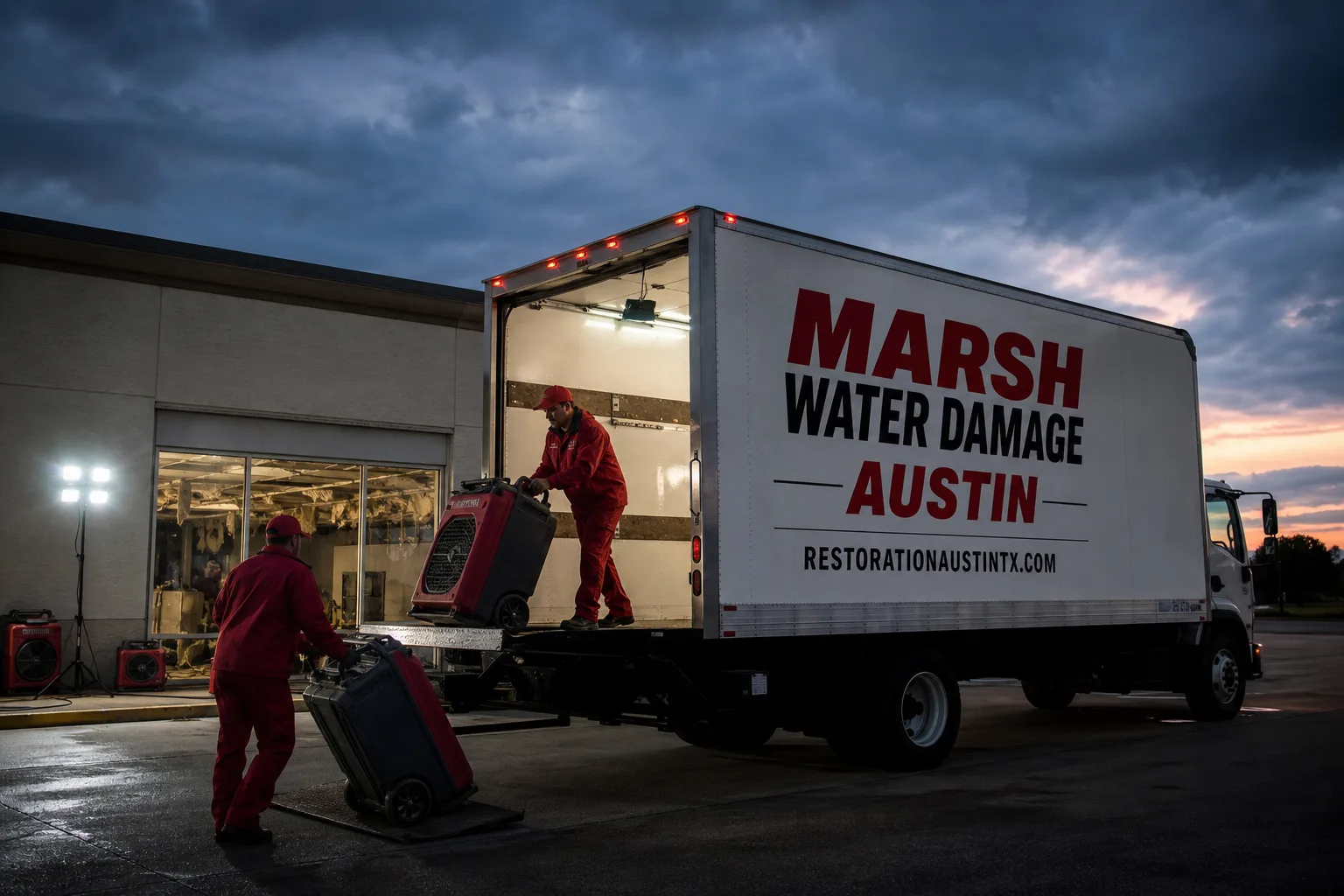
Our crews are trained and credentialed through IICRC, RIA, and IFA, and we standardize on Dri-Eaz and Phoenix equipment because both brands hold up under continuous load and their performance data is predictable. We keep a stocked trailer of air movers, dehumidifiers, and extraction units dedicated to Camp Swift and the surrounding Bastrop County area, which shortens setup time on emergency calls. If your home already has a moisture problem behind brick veneer or under a pier-and-beam floor, we’re set up to start drying within the hour.
Common Water Damage Restoration Problems We See in Camp Swift Homes
- Hidden crawlspace pooling on sandy soil. Camp Swift’s east side has sandy, loose soil that lets water pool under pier-and-beam homes. Homeowners notice a damp smell first, then flooring starts cupping days or weeks later. By the time it’s visible, the subfloor has already been wet long enough to feed mold.
- Creek floodwater misclassified as clean water. Camp Swift sits near creeks that overflow during flash floods. That water picks up soil, sewage, and agricultural runoff. Treating it as a category 1 clean water leak skips the antimicrobial step and leaves contamination behind. We test and treat accordingly.
- Hidden moisture behind 1970s brick veneer. Many Camp Swift homes from the 1970s have brick veneer over wood framing with no drainage plane. When water gets behind the brick, it sits there. We see mold colonies form within 48 hours, invisible from inside or outside. Moisture mapping finds it before it spreads.
- Fast-growing vegetation hiding storm damage. The area’s quick-growing shrubs and trees can hide roof damage after a hailstorm or high-wind event. Water enters through a small puncture, travels down a rafter, and soaks a ceiling corner that looks dry from below. We check the whole path, not just the visible stain.
See the difference
 Before
 After
After Before
 After
After Before
 After
AfterPricing for Water Damage Restoration in Camp Swift, TX
We Also Serve Cities Near Camp Swift
If you’re in Camp Swift, we’re already local to your neighborhood. We also serve nearby communities including Austin, Georgetown, Cedar Park, and Brushy Creek. Same Threshold Verified crews, same 24/7 live-answer dispatch line.
Serving Camp Swift, TX - Our Local Coverage Area
We’re based in the Camp Swift area and know this community well. Use the map below to see our service coverage - if you’re nearby, we can almost certainly help.
FAQs About Water Damage Restoration in Camp Swift
Mold can start within 24 to 48 hours in a Camp Swift pier-and-beam crawlspace when humidity stays above 60%, which is common after a flood. Sandy soil holds water close to the subfloor, and the warm, humid air accelerates growth. Call us at (361) 315-6142, and we’ll get a crew out to start drying before the clock runs out.
Floors warp in Camp Swift homes days after a storm because water pools underneath pier-and-beam foundations, where the sandy soil shifts and lets water sit against the subfloor. The wood absorbs moisture slowly, and the visible cupping or buckling shows up after the fact. We check the crawlspace first, even when the living space looks dry.
Yes, creek floodwater in Camp Swift is category 2 or 3 water, which means it carries soil, sewage, and bacteria that clean water from a supply line doesn’t. That requires antimicrobial treatment and more aggressive drying. We test the water category on site and treat it accordingly. Call (361) 315-6142 if you’re unsure what you’re dealing with.
The first thing we do in a brick-veneer home is stop the water source and take moisture readings behind the brick and inside wall cavities, because water hides there and feeds mold within 48 hours. Then we extract standing water, set drying equipment, and map the affected area so nothing gets missed.
Structural drying for a Camp Swift slab home typically takes three to five days, depending on how far the water traveled and how long it sat before we arrived. We monitor moisture in the slab and wall cavities daily and pull the equipment only when the numbers show the structure is genuinely dry. We’ll give you a written drying plan and a written guarantee.
Call Marsh Water Damage Austin for Camp Swift Water Damage Help
When water is in your home, the damage is spreading while you wait. And the crew you call matters as much as the equipment they bring. Marsh Water Damage Austin sends background-checked, photo-badged technicians to Camp Swift with a written price in hand before any work starts. Every job includes our 365-Day Done Right Promise: if the repair isn’t right within a full year, we make it right, and a second visit is included free. Call (361) 315-6142 now, and a live person will answer.
Written by Tobias Reyner, Owner at Marsh Water Damage Austin, serving Camp Swift and the surrounding Bastrop County area since 2005.